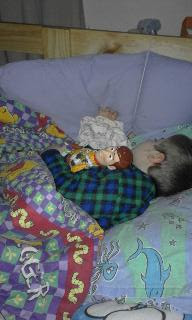
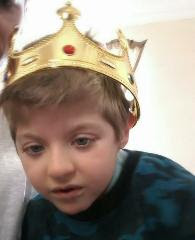
Sharing the journey of Sam the Conqueror, a medically-complex, differently-abled warrior whose precious spirit refuses to surrender to the limits imposed on him by his multiple diagnoses : Rubinstein-Taybi Syndrome, Cerebral Palsy (Periventricular Leukomalacia and Static Leukoencephalopathy) and Epilepsy.
Sam. Conqueror. Overcomer.
Our world has crashed, been blown apart.
This can't be happening....why us? Why now?
Your fragile life shaken before it could barely start,
How do we get through this...please, Lord, tell us how?
Drowning in our sorrow, waiting for answers that just don't come.
Our baby "special needs"? It simply can't be true!
The heartache overwhelms us, we're left feeling cold and numb.
The diagnosis tells us little - these children are so few.
But then we finallyget to touch you, to see your precious face
And all the heartache and questions fade, replaced with love and pride.
It's obvious from the very start you're showered in God's grace,
And with His love and guidance, we'll take this challenge in stride.
When once we couldn't pronounce it, Rubinstein-Taybi's become our norm.
When once the future seemed dark, we now welcome the journey as having an RTS angel brings lessons in unexpected form.
Our world has crashed, been blown apart!
This IS happening....to us.....right now!
We've been blessed with a gift, so precious from the very start. How do we get through this? Here's how.....
By believing in a God, so merciful and great,
By trusting that He's right beside us as we journey through the narrow gate.
By believing His love for us is not determined by a human frame,
By trusting that we draw Him near by merely calling His name. This precious baby we asked God for,
Prayed he'd be perfect and complete.
And, as Samuel means "God hears", He's laid His answer at our feet.
(Nicky de Beer : 27/05/2010)
Wednesday, October 7, 2015
When you're missing a part of you...
Wednesday, September 16, 2015
From Smurf to Ninja King

Monday, August 31, 2015
Potential Capped
Monday, August 3, 2015
The Darkness Cometh!
Although the meds certainly did help some, I kept thinking back to those night's of blissful sleep in the hospital despite Sam actually being really ill. The major difference between hospital and home was that at home Sam was still sleeping in our bed, smack-bang in the middle to prevent him from hurting himself when bashing, while at the hospital he slept in his own bed. So Thursday we decided to go out on a limb and move house without the actual benefit of a brand new house....in other words...rearrange our bedroom, which in turn meant rearranging almost the entire house! Sam's bed was relieved of the storage facility it had merely become and pushed snug up against our own bed (baby steps). And? Well, with some very light bashing every night around 1am every night, Sam has been sleeping comfortably there ever since. As much as what he wants to sleep in our bed, being in his own bed is obviously far more comfortable and, it seems, partly responsible for his disrupted sleep. And of course the quality of sleep I am getting being able to actually relax my muscles without the fear of falling off the 10cm little scrap of bed I was left to rest on each night, is quite delightful too. Sam's still battling with his teething, his super-flushed cheek and relentless teeth-grinding tells me so...but he is at least getting a decent amount of sleep at night now. And who knows? Maybe the next six years will see us actually moving his bed a couple of cm's apart from ours....the sky's the limit folks.
Thursday, July 2, 2015
People = Happiness
Friday, June 12, 2015
Shared paths - Here's to you, my friends!
Thursday, May 28, 2015
Mommy Malfunction
If I had a Rand for every time I've said that in the last six years, I'd be hobknobbing with the Ruppert's. After six night's of Sam managing a maximum amount of sleep of around two hours (the rest of the night spent bashing himself violently from side-to-side) through uncontrollable tears and stifled sobs, I typed an e-mail to Prof Prof (a nearby paediatrician Sam saw very briefly last year when my injured ankle prevented me from driving) at 1:10am on the Tuesday morning, asking if I would be causing any harm by putting Sam back on the Risperdal! I only half expected a reply seeing as Prof Prof had not benefited from having Sam as a longterm patient (we had only seen him twice and the second visit, after hours of all things, he had not charged us for as I had mistakenly imagined seeing something in Sam's ear. #sigh ) but low-and-behold, at 1:34am my tablet lit up. A reply! With an instruction to give him a call in the morning. More sobbing...but this time full of thankfulness.
After a quick phone call the next morning to explain the situation and my reasoning for wanting to stop giving Sam the Risperdal (which had been my wanting to limit the amount of chemicals we are pumping into Sam's system on a daily basis, relying on natural remedies instead, especially as I had not seen a significant improvement in Sam's quality of life since starting Risperdal) Prof Prof a) refrained from berating me for opting for the natural remedies and instead reassured me that for peace of mind, it was good that I had at least given it a go and b) suggested that we immediately put Sam back on the Risperdal on the same dose he was previously on, but administered differently, ie. instead of a once daily dose, splitting the dose in two which should almost immediately settle my first complaint, that the Risperdal was not helping Sam during the day. After a quick chat over the phone with our local pharmacist, I was advised that I could go collect Sam's Risperdal that very evening.
This week has been a complete contrast to last week. On Monday we headed off to our most dreaded chore, shopping. There was probably a total of seven items on the list which would usually be carried out in a frantic 10-mintue whirlwind. This time Sam was so calm that Meg and I actually dragged our feet a little and I half-wished there was other things I needed to buy in order to take advantage of Sam's not-often-seen content being pushed around the shop. Yesterday afternoon we had an appointment with Prof Prof, who was running a little late due to an emergency. After a half-hour wait Sam would normally have been climbing the walls...or painting them with something other than paint. Although he did protest loudly whenever a baby cried, he was so unbelievably good and not once did he strike out when anyone came too close to him - this alone is a HUGE change!
After sharing an impromptu slideshow presentation with me, as well as the benefits of using certain medication to help improve the quality of life for a child with Autism and reassuring me that I am not "frying" Sam's brain with the rather lengthy list of medications he takes daily, Prof Prof made probably one the most profound statements to me that anyone has done in a long while...
Many, if not most, of Sam's RTS peers have Autistic traits which often present in sensory challenges. However, I believe, their "main" diagnosis remains Rubinstein-Taybi Syndrome. Should you remove that funky little CREBP Gene from their genetic make-up, the chances are their Autistic traits and the sensory challenges related to it would quite likely disappear too. I shared a sentiment here quite some time ago though that, should we be in the glorious position to somehow completely remove both RTS and Cerebral Palsy from Sam's system...he would still be dealing with the exact same challenges he faces now on a daily basis....perhaps just without those funky little thumbs and the several scars he bravely wears reminding us of some of the more severe medical conditions related to RTS.
In summing up our consultation yesterday afternoon, Prof Prof started with "So, we're dealing with Autism and Cerebral Palsy with underlying Rubinstein-Taybi"! Oh my gosh! I almost started bawling right then and there. Someone gets it...someone sees passed the RTS and acknowledges and understands the significantly larger role Autism is playing in our lives. We left the hospital feeling more focused and 'together' than we have in a very, very long time. And I say "we" because somehow Sam seemed more peaceful too, firstly by eagerly signing "doctor" when I pulled the car into the garage and secondly by having such an incredibly good night's sleep last night that I had to keep putting my hand on him to make sure he was breathing!!!
And, to add yet some more positivity and hopefulness to this week, we got to have another SNAP Lite session with Aunty Annelies. I still can't get over how mesmerised Sam is by her. When she's sitting on the floor working with him, Sam is almost unrecognisable. She keeps him so focused and capable...the results she draws from him are amazing and not to mention what a wealth of information she is with all sort of wonderful "tricks", like using playdough to help train the brain to see and recognise outlines.
Wednesday, May 13, 2015
Swing High, Swing Low...
On a recent afternoon, JD Bailey was trying to get her two young daughters to their dance class. A work assignment delayed her attempts to leave the house, and when Bailey was finally ready to go, she realized that her girls still didn't have their dance clothes on. She began to feel overwhelmed and frustrated, and in the car ride on the way to the class, she shouted at her daughters for not being ready on time. "Suddenly I was like, 'What am I doing?'" she recalls. "'This isn't their fault. This is me.' "
Bailey has dealt with anxiety for as long as she can remember, but it has become more acute since the birth of her second daughter, when she began to experience postpartum depression. She knows that her anxiety occasionally causes her to lash out at her daughters when she doesn't really mean to, and she can see that it affects them. "You see it in your kids' face," Bailey says. "Not that they're scared, but just the negativity: 'Oh my God, my mommy's upset.' You're their rock. They don't want to see you upset."
Witnessing a parent in a state of anxiety can be more than just momentarily unsettling for children. Kids look to their parents for information about how to interpret ambiguous situations; if a parent seems consistently anxious and fearful, the child will determine that a variety of scenarios are unsafe. And there is evidence that children of anxious parents are more likely to exhibit anxiety themselves, a probable combination of genetic risk factors and learned behaviours.
It can be painful to think that, despite your best intentions, you may find yourself transmitting your own stress to your child. But if you are dealing with anxiety and start to notice your child exhibiting anxious behaviors, the first important thing is not to get bogged down by guilt. "There's no need to punish yourself," says Dr. Jamie Howard, director of the Stress and Resilience Program at the Child Mind Institute. "It feels really bad to have anxiety, and it's not easy to turn off."
But the transmission of anxiety from parent to child is not inevitable. The second important thing to do is implement strategies to help ensure that you do not pass your anxiety on to your kids. That means managing your own stress as effectively as possible, and helping your kids manage theirs. "If a child is prone to anxiety," Dr. Howard adds, "it's helpful to know it sooner and to learn the strategies to manage sooner."
It's tempting to protect kids from things that make them anxious, but learning to tolerate anxiety is how we overcome fears.
Learn stress management techniques
It can be very difficult to communicate a sense of calm to your child when you are struggling to cope with your own anxiety. A mental health professional can help you work through methods of stress management that will suit your specific needs. As you learn to tolerate stress, you will in turn be teaching your child—who takes cues from your behavior—how to cope with situations of uncertainty or doubt.
"A big part of treatment for children with anxiety," explains Laura Kirmayer, an associate psychologist at the Child Mind Institute, "is actually teaching parents stress tolerance, It's a simultaneous process—it's both directing the parent's anxiety, and then how they also support and scaffold the child's development of stress tolerance."
You might find yourself learning strategies in therapy that you can then impart to your child when she is feeling anxious. If, for example, you are working on thinking rationally during times of stress, you can practice those same skills with your child. Say to her: "I understand that you are scared, but what are the chances something scary is actually going to happen?"
While you don't want your child to witness every anxious moment you experience, you do not have to constantly suppress your emotions. It's okay—and even healthy—for children to see their parents cope with stress every now and then, but you want to explain why you reacted in the way that you did. Let's say, for example, you lost your temper because you were worried about getting your child to school on time. Later, when things are calm, say to her: "Do you remember when I got really frustrated in the morning? I was feeling anxious because you were late for school, and the way I managed my anxiety was by yelling. But there are other ways you can manage it too. Maybe we can come up with a better way of leaving the house each morning."
After JD Bailey lost her temper at her daughters on their way to dance class, she made sure to explain her reaction, and then focused on moving forward. "I said, 'I'm sorry. Mom is a little stressed out because I have a lot of work going on. Let's listen to some music,' " Bailey recalls. "We cranked up the music in the car, and it changed our mood."
Come up with strategies in advance for managing specific situations that trigger your stress. You may even involve your child in the plan. If, for example, you find yourself feeling anxious about getting your son ready for bed by a reasonable hour, talk to him about how you can work together to better handle this stressful transition in the future. Maybe you can come up with a plan wherein he earns points toward a privilege whenever he goes through his evening routine without protesting his bedtime.
These strategies should be used sparingly: You don't want to put the responsibility on your child to manage your anxiety if it permeates many aspects of your life. But seeing you implement a plan to curb specific anxious moments lets him know that stress can be tolerated and managed.
Trying to parent while struggling with your own mental health can be a challenge, but you don't have to do it alone. Rely on the people in your life who will step in when you feel overwhelmed, or even just offer words of support. Those people can be therapists, co-parents, or friends. "I am a part of an actual support group, but I also have a network of friends," says Veith. "I am open with friends about who I am, because I need to be able to call on them and ask for help. "
Of course, not all of this points are practical suggestions when dealing with Sam...I think only the first three tips might be relevant, but still a helpful article nonetheless!
Tuesday, April 28, 2015
Fight-Flight 101
An interesting bit of info I read recently is that Risperdal can heighten anxiety issues. Very interesting. Especially as I sit here on a daily, sometimes hourly, basis trying to figure out where all these extra anxieties have come from. Now it's no secret that I am not Risperdal's No.1 fan, almost instantly Sam became over-emotional and insatiably hungry. But I figured a little sporadic sobbing and healthy appetite was a small price to pay if there was noticeable improvement in other areas, like sleeping and social behaviour. The thing is, there's been no noticeable improvement in those areas so at this stage the negatives are outweighing the positives. I am still cautious about taking Sam off the Risperdal though, so have opted for the most conservative weaning process which is decreasing his dose by 10% every 3-4 weeks which effectively means that Sam will only be Risperdal-free at the end of June.
Trying to figure a way forward with Sam's social development has made me realise that we do not give Sam's anxiety issues enough credit for the role they play in his social interaction. Sam comes from at least two generations of severe anxiety sufferers (a story for another day but, yes, genetics do play a role in anxiety disorders), compounded by an under-developed nervous system from being born prem and needing the many medical procedures his special needs required with only this under-developed sensory base to comfort and stabilise him. I am an adult with a fully-functioning cognitive system (well most of the time) from which to draw the rationale which would help me process all the 'trauma' in my life, like surgeries, etc and yet still I can quite comfortably say that I'd be close to a nervous wreck having dealt with some of the challenges Sam has.
HOW TO RECOGNISE ANXIETY IN CHILDREN WITH SPECIAL NEEDS
Fear is a normal part of childhood. But for many kids with special needs–kids who’ve experienced scary medical procedures, separation from their parents, constant pain, and other situations they shouldn’t have to endure–anxiety can become debilitating or lead to post-traumatic stress disorder (PTSD). When it does, parents and other caring adults need to step in and help them find treatment.
5 Symptoms of Anxiety in Kids
But how can we know when ordinary childhood fear has morphed into debilitating anxiety? A post at Lending Hand Resources lists the following 5 symptoms.
• Your child doesn’t want to leave the house. To the point where they avoid it or display fear and sadness when forced to leave.
• Your child is always angry. Anxious children are angry because they feel trapped.
• Your child is always sick. Anxious kids fear the worst. So they over react to the slightest headache or heart flutter.
• Your child sweats constantly. This is a natural physical reaction for kids who are always ready for flight or fright.
•Your child can’t sleep. Anxiety leads to racing thoughts. And who can sleep with all that head noise?
The entire article can be found at Is Your Child Suffering from Anxiety? Five Symptoms to Look For.
Just one of the more basic articles on anxiety, but still significant in identifying many of our issues with Sam.
The first major step is a change is mindset, from my side. I have lived most of my life with anxiety and on more than one occasion needed medication to help me cope, so one would think I would automatically have this built-in alarm system which would perfectly guide me to a more tranquil little dude, right? Wrong! Sometimes my desire to see Sam enjoying something 'normal' overides my judgement, like yesterday afternoon. We took a drive to the waterfront, not anticipating how frightfully busy it was going to be. Meg and Chris were inside the mall trying to find something to drink but the noise levels were unbearable in there so I pushed Sam outside for a few mins of as-close-as-we'd-get to some quiet. I'd barely got outside when Sam spotted the Big Wheel which, thanks to Mr Tumble, he gestured excitedly at and signed "big wheel". Mommy brain cheered "Yay! Sam likes!" and instantly pushed Sam closer while sensory-cautious brain lay trampled on the ground.
I have told so many people so many times that Sam likes everything from a distance, I don't know what I was thinking by pushing him closer to the Big Wheel, especially as it meant dealing with the extra noise from all the outside eateries. 50 metres from the wheel and smack bang in the middle of all the folks enjoying their meals Sam went into screech-overload, ironingboard-mode! Chris calls it surfboard-mode, go figure ¶: Either way, you're dealing with a 20kg kid who is in full startle extension, screeching at a pitch that would put a fire engine's siren to shame. In hindsight, it must have been pretty darn entertaining...153cm high, stress-relief smoothie (of all things) yielding woman trying to remove said panic-stricken dude from pushchair...with one hand nevertheless. It was by far our most traumatic social meltdown EVER! And this without vomit even. Me thinks we'll do the hermit thing again this week. No wait, what am I saying...Meg has a soccer match tomorrow. Oh my fragile heart.
And in other, nowhere near as exciting news...
Wednesday, April 1, 2015
Special Needs parents are hard to get along with...
A piece by Ellen Stumbo....
"Perhaps some of us special needs parents have snapped, yelled, spit, or barked at friends or family, leaving them utterly confused about our behavior. Who can blame them for thinking, “Well that’s the last time I talk to her!” “What’s wrong with him?” “Is his disability sarcasm? He is so rude!” “Every time I talk to her I’m walking on eggshells!”
Someone googled, “Why are special needs parents hard to get along with.” And well, I don’t blame them for feeling that way…sometimes.
So let me start by saying that yes, sometimes, we are hard to get along with. If you caught us on a bad day, I could see why you turn around and walk away the next time you see us. But that is not the whole story. Yes, sometimes we can be abrasive and rude and sarcastic and hard to get along with…but there is a reason.
You see, so much of the world sees our kids as unlovable, as people without value, as a burden. Even the professionals that are supposed to be on our team can unfortunately communicate that our children’s lives have less meaning, and those messages might even come from the people who are close to us, like family or friends.We feel so alone, but if we don’t fight for our kids then who will?
And we fight, we fight so hard for our children to be included, to be considered, to be given a chance. We are on the defensive, constantly. It’s a battle, a battle that sometimes keeps us up at night, and unfortunately, we have to keep our guard up so often that we forget that there are times when we can put the guard down.
Sometimes we might be hard to get along with. But not always.
I think you would agree that it’s not easy being a parent. Being a special needs parent feels a little bit more challenging.
Would you extend me some grace and know that I have hard days? Will you be willing to forgive the rudeness and the fight? Some days I feel so vulnerable that ugliness comes out, when really, what I need is a friend, someone that I can talk to, someone that will listen, just listen.
And I need to remember that too. I need to extend that same grace to you, because you do not live a life directly impacted by disability, and I cannot expect you to be at the same place of understanding I am at when this is not your life.
I knew so little about parenting children with disabilities when I started this journey. Actually, I knew so little about being a parent before I became a mother! I am still doing the best I can for all my kids, learning, messing up, some days getting things right. Being a special needs parent is not something that anyone can be prepared for. You just have to live it.
So I am sorry if I have ever offended you, it was not my intention. And I need to remember that as well, that you never intended to be offensive either. If I am hard to get along with, please offer me some grace. I will do the same for you. I know I need to extend the same consideration I want to receive back.
I need your friendship, I need your support. And I like to believe that you need mine too, because this giving and taking is part of friendship.
Let’s do some more grace giving, some more forgiving, some more laughing, some more, “No big deal!”
A postscript: Some people are simply mean and inconsiderate human beings who have no qualms at making derogative comments. Well then, you had that coming, nobody messes with our kids."
So. This post. Special Needs parents hard to get along with? Are we really? Occasionally a little over-emotional maybe, crazy-passionate about advocating for our kids here and there...distracted by lack of sleep sometimes, forgetful of the odd birthday or therapy appointment...Oh no, hang on! That's just me ¶:
But I'm not sold on the "hard to get along with" thing. We're a growing community of special needs parents here in our little piece of the world and I'd hardly refer to any one of these people as hard to get along with, especially in a way as described in this article.
Sure we have bad days, you know, like everyone does. Sometimes the unending struggles our kiddo's deal with can dampen the spirits ever so slightly. I know I went through a self-inflicted stage of solidarity...I felt it was inconsiderate of me to burden others with some of the more challenging of Sam's social/anxiety issues so playdates and party invites were regularly and repeatedly graciously declined. The thought of having the hard work a friend has put into her child's birthday party ruined by a puking little dude was as heartbreaking as the thought of strangers thinking badly of my little dude, possibly meeting him for the first time.
(An interesting sidestep about Sam's vomiting in public - most people presume that I've made a poor decision as a parent by taking my sick child out in public, which is also a little troubling. After often being asked if Sam's sick, I now find myself explaining frantically to anyone within earshot that the throwing up is just a result of his high anxiety levels)
But rude? Ugly? Abrasive? I don't believe I've ever been any of these to anyone I might call friend (or stranger for that matter) and having a child with special needs certainly wouldn't give me an excuse to be so. Almost everyone is fighting a battle of some sort, imagine if everyone going through a rough patch adopted this attitude? I've a feeling that if you're prone to snapping, yelling, spitting and/or barking at friends, it's a part of your personality that would be there whether you were parenting a child with special needs or not.
An article like this does worry me a little as it could well deter someone from making a connection with the parent/s of a child with special needs. Of course, I cannot speak on behalf of my own friends who might well consider me hard to get along with...but if this be the case then they're pretty darn awesome friends for sticking with me through it all....
Sunday, March 29, 2015
The unchanging....
If I had a Rand for every person who's ever told me how great it is that I can remain lighthearted about most of our challenges, I'd have...well a handful of Rands...enough to buy a lottery ticket and put me in the runnings to become a MILLIONAIRE! (As long as "millionaire"'s somewhere in that equation, right?) Usually I laugh and say "Well, if I don't laugh, I'll cry...and if I start crying, I'm not sure I'd stop" and then we laugh some more.
Few realise how completely honest I am being.
Some days I just can't muster the energy to fake okay. Today is one of those days.
Sam has many issues relating to his RTS, Cerebral Palsy and Autism. Some are pretty straightforward...reflux, constipation, etc...some are more serious...apnoea, physical abnormalities, odd seizures, etc. I can live fairly peacefully with almost all of these and the care they require. They are all tangible issues...things I can feel or see or smell or hear. They are all fairly common issues too, maybe not always effecting one person at the same time, but isolated they are all issues that when discussed with someone else they are easily recognised and relatively easy to treat, whether it's upping Movicol, reducing fluids before bed, sleeping on a wedge, having regular physiotherapy - they are mostly tangible problems with tangible solutions.
They are the easiest part of our journey.
And the hard part? The hard part is something that cannot be seen or heard or felt or smelled. If you sent Sam for an MRI/scan/scope it would not show up like a tethered spinal cord or malfunctioning oesophagul valve or thickened bowel wall or funky airways or Periventricular Leukomalacia or any of the other things responsible for the above ailments.
FEAR!
Irrational, uncontrollable, all-consuming, life-draining FEAR!
You just cannot begin to imagine what sort of fears a 5 year old could possibly have that might be anywhere near as debilitating as what I'm trying to imply. Let me blog you through our last 36hrs....
After averaging yet another night of only 3-4 hrs sleep, Sam woke grumpy, with a grumbling tummy due to his growing aversion to anything remotely resembling food and the sight of his dad in bed next to him. Yes, sounds like a harsh statement for me to make but Sam knows that Dad not going off to work means weekend which in turn means a change to his daily routine. Pediasure bottle made and handed to shaking hands - Sam has a fear of liquid moving, whether it's waves at the beach, water from a sprinkler, water poured over him in the bath or, as in this instance, milk swishing about in his bottle. It takes him a good few minutes to build up enough courage to put the swishing milk to his lips, almost choking as his shaking prevents him from swallowing calmly. Still, it's an accomplishment as sometimes fear trumps hunger and the bottle goes flying to the floor as if it might cause him physical harm. Fear 0 : Sam 1
Once we're all showered and dressed, off to the kitchen to prepare Sam's porridge. Throwing good parenting skills out the window, I put Sam in front of the TV with his favourite show hoping it will distract him enough to at least tolerate a few spoonfuls. Fail. The second I bring the bowl in he starts gagging. Fear 1 : Sam 1
Dad leaves to drop his car off at service garage. Needing to follow shortly so that I can collect Dad and we can go to shops, I opt for another Pediasure bottle. Sam spots bottle entering the room, gags and throws up what's left of the previous bottle. Fear 2 : Sam 1. Off to fetch dad and brace month-end shoppers on an empty stomach. Or so I thought.
Arrive at service place, walk into dimly-lit garage to see how it's going with car. Sam starts gagging. Mom does not panic as there can be precious little left in the kid's stomach. Wrong! Sam showers the parking lot and mom with a surprising amount of fermenting Pediasure. Fear 3 : Sam 1
Back home to shower and de-puke. Survived a thankfully uneventful shopping trip for nappies and Pediasure. Once home and after yet another food-sighting-induced-gag-session, Sam manages about 5 spoons of mashed potatoes and 120mls of Pediasure. Desperate to have this small helping actually digested, remain at home. Another night of restless, body-bashing follows.
Sam wakes a little more cheerful this morning until his bottle is placed in his hands. More gagging, but luckily this time puke-less. Same story as yesterday when porridge bowl is spotted. Surrender and head off once again to supermarket for the rest of the family's needs. Barely in shop a few minutes when employee decides to remove the strip which keeps the prices in place on the shelves. The 'ripping' noise sends Sam into instant gagging mode and over the next few minutes, Sam empties his entire stomach's contents (?) all over the trolley, shop floor and himself. Mom flees with vomit-saturated kid and scarlet-faced teenager, leaving Dad to finish the shopping. Back home for bath and de-puking. Before heading back to shop to collect Dad, Mom swings by local church to collect two generously gifted items for her new playgroup. Upon pulling into the unfamiliar parking lot and choosing to park right in front of the open doors, a motherload of Pediasure is projected from Sam's stomach. Sam, carseat and car's seat all drenched. Phone Dad to advise we are headed home first for de-puking. Once Dad and groceries have been collected, retreat to our cave giving up (once again) on the Sunday afternoon family outing.
Washing machine works overtime for the remainder of the day, family members tiptoe around with their own food to avoid further gagging and eventually, after a mere 320mls of Pediasure for a straight 24hr period, Sam falls asleep exhausted from a day filled with unexplainably frightening things.
Mom sits next to him on the bed, listening to his grumbling tummy and shushing him when he whimpers in his sleep, feeling helpless and lost about how to help him. Is it possible to avoid all the things that cause her 5 year old so much anxiety? Yes, of course...but it means never leaving home. She wipes the tears from her cheeks as she reminds herself that no-one gets this part of Sam...of their lives, especially the doctors and specialists...and realises that until someone does, it can't ever change.
FEAR 54785588 : MOM 0